USA
USA
 Pakistan
 Singapore
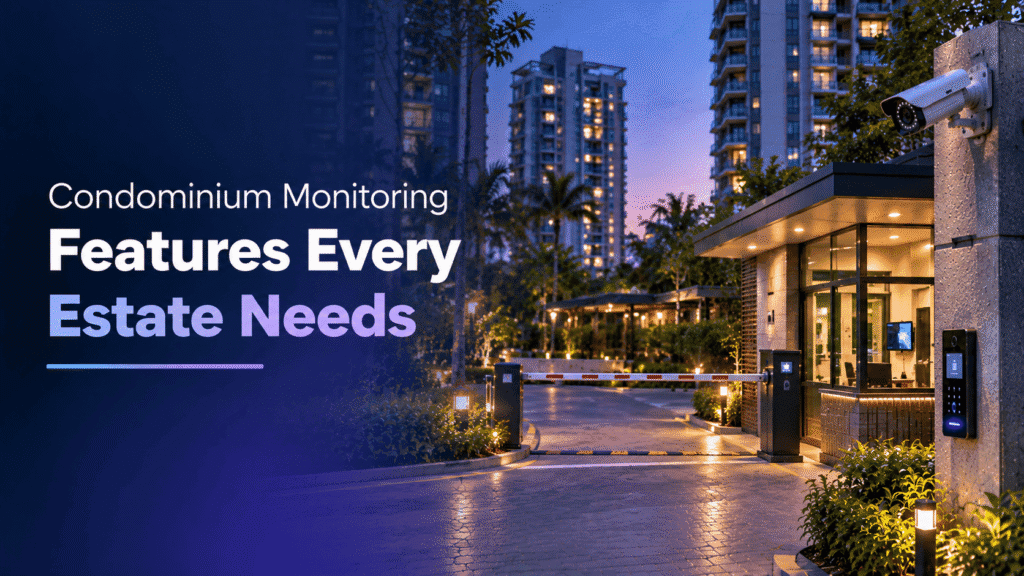
7 Condominium Complex Monitoring Features Every Singapore Estate Needs
Managing security across a condominium isn’t the same as securing a single home. Shared lobbies, multiple gates, car parks, and dozens of unit entrances all need coverage at once, and a handful of guards on rotating shifts can only be in so many places.
Condominium complex monitoring today leans heavily on remote systems that combine cameras, access control, and live verification, closing the gaps that a purely manpower-based setup tends to leave open. Here are the seven features MCSTs and estate managers are prioritising, and where the biggest blind spots usually sit.
TL;DR
- Condominium complex monitoring works best as a layered system: cameras, access control, and live verification working together, not any single feature alone.
- Remote condo security monitoring is helping estates cut manpower costs while covering more entry points than physical guards alone can manage.
- Common areas like car parks, lift lobbies, and back gates need the same level of coverage as the main entrance.
- A condominium visitor management system reduces reliance on manual logbooks and unverified gate checks.
- MCST security solutions Singapore providers should be able to explain how they handle personal data captured on camera, in line with PDPA requirements.
What Is Condominium Complex Monitoring?
Direct answer: Condominium complex monitoring is the use of cameras, access control systems, and live verification to watch and manage every entry and common area across a condo estate, rather than relying only on guards stationed at the main gate.
A single guard checking IDs at the front barrier can’t also watch the back gate, the car park, and the pool area at the same time. Remote guarding services extend coverage across every one of those points simultaneously, with alerts routed to a live team the moment something looks off.
7 Condominium Complex Monitoring Features Every Estate Needs
1. Remote Visitor Verification at the Main Gate
Instead of a guard manually noting down particulars, some Singapore condos now route entry through a speaker and camera connected to a remote command centre, where an operator verifies the visitor and vehicle before lifting the gantry. This kind of setup pairs naturally with an access control system, since the same verification step can log entry automatically rather than relying on a handwritten book.
2. Coverage of Every Common Area, Not Just the Entrance
Car parks, lift lobbies, and back gates are common blind spots because attention tends to focus on the main entrance. Outdoor surveillance across the full perimeter, not just the front gate, closes off the side and rear access points that opportunistic intruders typically look for first.
3. A Digital Visitor Management System
Paper logbooks get filled in inconsistently and are hard to search after an incident. A condominium visitor management system tied to intercom monitoring records who buzzed in, when, and for which unit, giving management a searchable record instead of a stack of handwritten entries.
4. Live Monitoring Instead of Recording-Only Cameras
Cameras that only record give you footage after something has already happened. Live security monitoring means a person is actively watching feeds and can react while an incident is unfolding, whether that’s a break-in attempt or a dispute in a common area.
5. Two-Way Audio for On-the-Spot Verification
Being able to speak directly to someone at a gate or lobby before letting them through adds a layer that cameras alone can’t provide. Two-way audio surveillance lets a remote operator question an unfamiliar visitor immediately, often resolving a situation before it needs escalation.
6. Remote Command Centre Support
Reducing the number of guards physically stationed on-site doesn’t have to mean reducing coverage. A virtual security guard working from a remote command centre can monitor multiple properties at once, stepping in the moment an alert is triggered rather than waiting for a scheduled patrol to pass by.
7. Coordinated Coverage for Gated Community Layouts
Estates with multiple blocks and shared facilities need monitoring that ties every access point into one system, rather than treating each block as a separate problem. Remote CCTV monitoring for gated communities connects these points together so an alert at one gate is visible to the same team watching the rest of the estate.
How Does Condo Security Monitoring Work?
Direct answer: Condo security monitoring works by connecting an estate’s cameras, intercoms, and access points to a remote team who verify activity in real time and act immediately when something looks wrong.
This shift has already reached several Singapore estates, where local security firms have spent years building remote visitor-logging systems that pair cameras with a command centre operator, rather than relying solely on a guard stationed at the barrier. Rising manpower costs under Singapore’s Progressive Wage Model for security officers have pushed more MCSTs toward this model, since it lets a smaller on-site team focus on patrols and incident response instead of manual logging.
Is Remote Monitoring Better Than Security Guards?
Direct answer: For continuous coverage across a large condominium complex monitoring system, remote monitoring generally covers more ground than a fixed number of guards can, though most estates get the best results from combining both rather than replacing one with the other.
Guards remain valuable for physical presence and on-the-ground response, but they can only be in one place. Pairing them with a CCTV monitoring for residential societies setup means every gate and common area still has eyes on it, even when the physical guard is elsewhere on patrol.
Choosing the Best Security System for Condominiums in Singapore
The best security system for condominiums Singapore estates adopt isn’t defined by camera count alone. It comes down to whether alerts are actually verified by a person and how quickly that verification turns into action, whether that’s an audio warning, a call to residents, or a report to police.
Before signing with an MCST security solutions Singapore provider, ask directly how they handle footage that captures identifiable faces or vehicle plates. Under Singapore’s Personal Data Protection Act, organisations collecting such footage have specific obligations around how it’s handled, and a provider who can speak clearly to this is generally a safer long-term choice than one who treats it as an afterthought.
Summary
Condominium complex monitoring has moved well beyond a guard checking IDs at the front gate. The estates seeing the best results combine remote visitor verification, full common-area coverage, and live monitoring that reacts in real time, backed by a smaller on-site team rather than one stretched thin across every entry point. For MCSTs weighing their options, the real question isn’t how many cameras to install, but whether every alert reaches someone who can act on it immediately, and whether the provider handling that footage takes data protection as seriously as physical security.
Frequently Asked Questions
What does condominium complex monitoring actually cover?
It typically covers the main entrance, back gates, car parks, lift lobbies, and shared facilities like pools or gyms, tying all of these into one monitored system rather than treating each as separate.
Do MCSTs need a condo access control system Singapore setup if they already have guards?
Yes, in most cases. A condo access control system Singapore setup logs entries automatically and covers points guards can’t watch continuously, which reduces reliance on manual checks alone.
How does a condominium visitor management system improve security?
It replaces handwritten logbooks with a searchable digital record of who entered, when, and for which unit, making it far easier to review after an incident.
Is condo common area surveillance different from unit-level CCTV?
Yes. Condo common area surveillance covers shared spaces like lobbies and car parks that no individual resident’s camera can capture, and is typically managed by the MCST rather than individual owners.
Can remote condo security monitoring fully replace physical guards?
Not usually. Most estates get better results pairing remote condo security monitoring with a smaller on-site guard presence, rather than removing physical guards entirely.
What should an MCST ask before choosing a condominium CCTV system Singapore provider?
Ask about response times, how alerts are verified before escalation, and how the provider handles personal data captured through cameras, since this falls under Singapore’s data protection rules.
Does condo footage capturing visitors’ faces fall under data protection law?
Yes. Footage capturing identifiable individuals is covered under the Personal Data Protection Commission’s advisory guidelines on CCTV, which set out how such recordings should be handled and retained.