USA
USA
 Pakistan
 Singapore
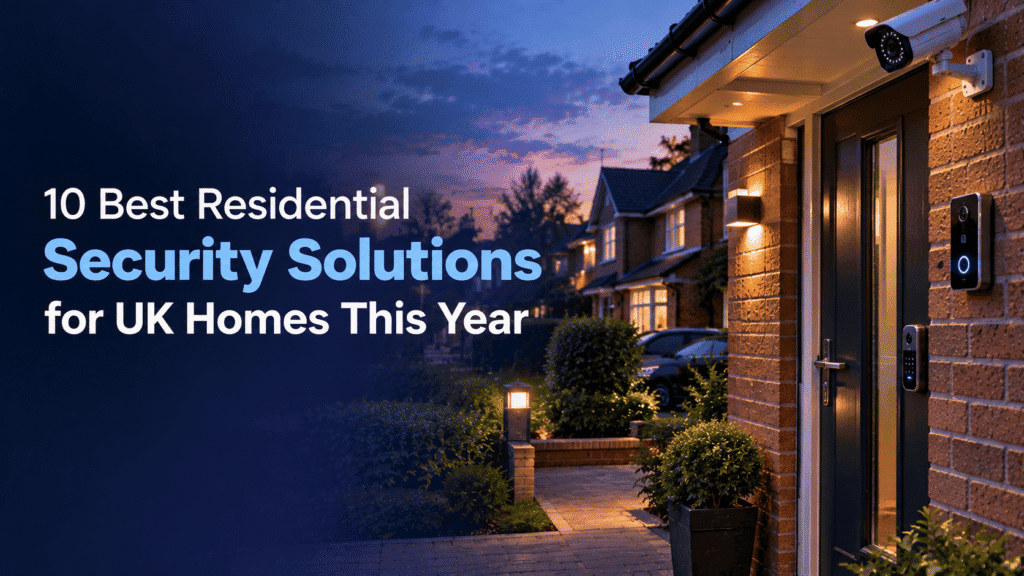
10 Best Residential Security Solutions for UK Homes This Year
Choosing the right residential security solutions can feel overwhelming — there are alarms, cameras, smart locks, doorbells, and monitoring services, all claiming to be essential. Not every home needs every option, but most UK homeowners benefit from combining a few of the right ones.
This guide breaks down the 10 best residential security solutions UK homeowners actually use, what each one does well, and how to decide which combination fits your property.
TL;DR
- Layering multiple solutions — cameras, alarms, and access control — works better than relying on just one.
- Secured by Design principles are the UK police’s own benchmark for reducing home burglary risk.
- Live-monitored CCTV deters intruders far more effectively than recording-only systems.
- Video doorbells are affordable and effective for visitor verification and parcel theft prevention.
- Smart locks and access control reduce the risk of lost or copied physical keys.
What Counts as a Residential Security Solution?
Direct answer: Residential security solutions cover anything designed to prevent, detect, or respond to unauthorised entry or activity around a home — from physical barriers to live-monitored technology.
Home security systems UK homeowners install typically fall into a few categories: deterrents (visible cameras, lighting), detection (alarms, sensors), access control (smart locks, intercoms), and response (live monitoring, emergency contact). The strongest setups combine more than one category rather than relying on a single device.
Why One Device Is Rarely Enough
A doorbell camera alone won’t stop someone entering through a back window. An alarm alone won’t identify who triggered it. Layering solutions closes the gaps that any single device leaves open, which is the core principle behind most professional home security recommendations.
10 Best Residential Security Solutions for UK Homes
1. Live-Monitored CCTV Installation
Direct answer: Residential CCTV installation UK homeowners choose with live monitoring is more effective than standalone recording cameras because a person is actively watching and can respond.
Residential surveillance with a live monitoring service means suspicious activity gets a real-time response — an alert, an alarm, or a call to the resident — rather than footage that’s only reviewed after an incident.
2. Secured by Design Building Standards
Direct answer: Secured by design homes UK are built or retrofitted to meet security standards set by the police-backed initiative of the same name.
According to Secured by Design, the UK’s official police crime prevention initiative, homes built to these standards see measurably lower burglary rates. This includes reinforced doors, secure window locks, and layout choices that reduce hiding spots near entry points.
3. Smart Home Security Systems
Direct answer: Smart home security UK systems connect cameras, sensors, and alarms to a single app, giving homeowners real-time alerts wherever they are.
These systems are popular because they combine several security functions — motion detection, door/window sensors, and camera feeds — into one manageable interface, without needing separate standalone devices for each.
4. Burglar Alarm Systems
Direct answer: Burglar alarm systems UK homes rely on remain one of the most effective deterrents, especially when paired with visible signage and a monitored response.
A loud, immediate alarm interrupts a break-in in progress, often causing intruders to flee before anything is taken. Alarms work best as part of a layered system, not as the only line of defence.
5. Video Doorbell Security
Direct answer: Video doorbell security UK homeowners install is one of the most affordable ways to verify visitors and deter parcel theft.
Video doorbells let residents see and speak to whoever’s at the door, whether they’re home or not. Some councils actively support this approach — Havering Council’s guidance on video doorbells and CCTV for tenant homes outlines how these devices should be used responsibly alongside existing security measures.
6. Smart Locks and Access Control
Direct answer: Smart locks remove the risk of lost, stolen, or copied physical keys by using codes, apps, or biometric access instead.
Paired with broader access control systems, smart locks also let homeowners grant temporary access to guests, cleaners, or tradespeople without handing over a physical key at all.
7. Outdoor Perimeter Surveillance
Direct answer: Outdoor cameras covering entry points, driveways, and gardens catch intruders before they reach the house itself.
Outdoor surveillance extends protection beyond the front door, which matters since many break-ins start with an intruder testing rear or side access points that aren’t visible from the street.
8. Two-Way Audio Systems
Direct answer: Two-way audio lets homeowners or a monitoring service speak directly to someone on their property, often stopping an incident before it escalates.
Hearing “you’re being recorded, please leave” from a live voice is a far stronger deterrent than a silent camera. Two-way audio surveillance is increasingly bundled into residential CCTV packages for exactly this reason.
9. Night Vision and Low-Light Cameras
Direct answer: Most burglaries happen after dark, so cameras that perform reliably in low light are essential, not optional.
Night vision monitoring ensures footage stays clear and identifiable even without external lighting, which matters both for deterrence and for any evidence needed afterward.
10. Intercom and Visitor Verification
Direct answer: Intercom systems let residents verify who’s at a gate or communal entrance before granting access, closing a common security gap for houses with secure driveways or shared entries.
Intercom monitoring is especially useful for homes with gated access, where a simple video doorbell isn’t enough to cover a separate entry point.
How to Secure Your Home Without Overspending
Direct answer: Start with the highest-impact, lowest-cost options — a video doorbell and basic alarm — then add live-monitored CCTV or smart locks as budget allows.
Affordable home security solutions UK homeowners use most often start small: a doorbell camera, visible alarm signage, and better door/window locks. From there, remote video surveillance and live monitoring can be added once the basics are covered, giving a layered system without a large upfront cost. It’s worth noting that any camera system should also follow the ICO’s guidance on domestic CCTV use, particularly around neighbouring properties and shared spaces, to stay compliant with data protection rules.
Summary
The best residential security solutions for UK homes rarely come down to a single device. Live-monitored CCTV, Secured by Design principles, smart locks, and video doorbells each cover a different gap, and combining even a few of them creates a far stronger deterrent than any one option alone. Homeowners don’t need every system on this list — but understanding what each one actually does makes it much easier to build a setup that fits both the property and the budget.
Frequently Asked Questions
What is the best residential security solution for a UK home?
There isn’t a single best option — live-monitored CCTV combined with a video doorbell and solid door/window locks covers the most common risks for most UK homes.
What is Secured by Design?
Secured by Design is the UK police’s official crime prevention initiative, setting standards for building design and security products that reduce burglary risk.
Are video doorbells enough to secure a home?
No. Video doorbells are effective for visitor verification and front-door deterrence, but they don’t cover rear entry points, so they work best alongside other measures.
How much does residential CCTV installation cost in the UK?
Costs vary based on the number of cameras, whether monitoring is included, and installation complexity, but basic systems are considerably cheaper than fully monitored setups.
Is CCTV monitoring worth it for a private home?
For many homeowners, yes — especially where break-ins, parcel theft, or previous incidents have already occurred, since live monitoring responds in real time rather than only recording.
Do smart locks make a home less secure?
Not when properly installed. Reputable smart locks use encrypted access methods that are generally harder to bypass than traditional key-based locks.
How do I choose a residential security company in the UK?
Look for a residential security company UK homeowners can verify — check for live monitoring capability, transparent pricing, and compliance with data protection guidance for any camera systems.