USA
USA
 Pakistan
 Singapore
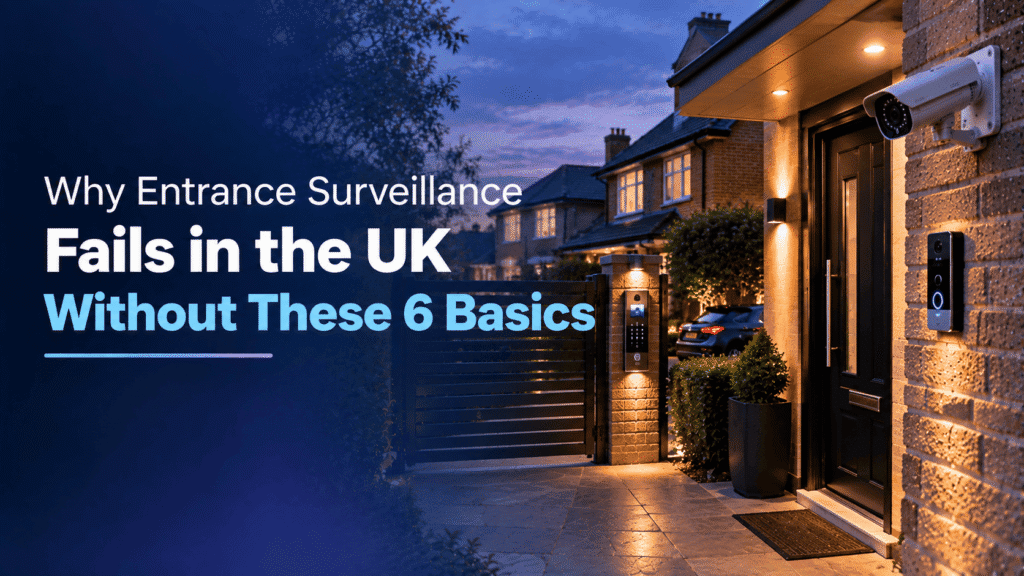
Why Entrance Surveillance Fails in the UK Without These 6 Basics
A camera pointed at the front door feels like enough. In practice, entrance surveillance fails far more often than homeowners expect — not because the camera is bad, but because the setup around it is incomplete. Footage sits unwatched. Visitors walk in unverified. Nobody responds until it’s too late.
This guide covers the six basics that separate entrance surveillance that actually works from a camera that just happens to be there.
TL;DR
- A camera alone isn’t surveillance — it needs monitoring, verification, and a response plan behind it.
- Most entrance failures happen at the same six points, regardless of property type.
- Video doorbells and full CCTV solve different problems and work best combined.
- Access control and intercom systems close the verification gap that cameras alone can’t.
- Following data protection guidance keeps entrance surveillance both effective and compliant.
Why Entrance Surveillance Fails More Than People Realise
Direct answer: Entrance surveillance camera UK setups often fail because the camera only records, with nobody watching in real time and no clear process for what happens when something’s caught on screen.
A recording is only useful after the fact. If nobody reviews it until days later, the surveillance has done nothing to actually prevent whatever happened at the entrance in the first place.
The Gap Between “Having a Camera” and “Having Surveillance”
Owning a camera and having working surveillance aren’t the same thing. Real entrance surveillance means someone — a person or an active monitoring service — is watching, verifying, and ready to respond. Without that, a camera is closer to a witness than a deterrent.
The 6 Basics Most Entrance Surveillance Setups Miss
1. Live Monitoring, Not Just Recording
Direct answer: The single biggest gap in most entrance surveillance camera UK installs is that nobody is actually watching the feed in real time.
Live security monitoring turns a passive camera into an active system, since a trained operator can respond the moment something looks wrong rather than reviewing footage after the fact.
2. Coverage Beyond the Front Door
Direct answer: Front door surveillance system UK setups often stop at the door itself, missing gates, driveways, and side access points entirely.
A camera pointed only at the front door leaves every other entry point unwatched. Gate entrance monitoring UK properties with driveways need is a separate layer, not an afterthought — someone entering through a side gate is just as much an unauthorised entry as someone at the front door.
3. Verification Before Access, Not Just Detection
Direct answer: Seeing someone at the entrance isn’t the same as knowing who they are or whether they should be let in.
Intercom monitoring closes this gap by letting residents or staff verify a visitor’s identity before granting entry, rather than relying on a camera that only confirms someone is standing there.
4. Access Control Instead of Physical Keys Alone
Direct answer: Entrance systems relying purely on physical keys create risk the moment a key is lost, copied, or shared informally.
Remote access control lets property owners grant or revoke entry instantly, without needing to change locks every time access needs to be managed.
5. Low-Light Performance for Night-Time Coverage
Direct answer: A large share of unauthorised entry attempts happen after dark, so entrance cameras need to perform reliably in low light, not just during the day.
Night vision monitoring keeps footage usable overnight, which matters both for deterrence and for anything that needs reviewing afterward.
6. A Defined Response, Not Just an Alert
Direct answer: An alert that nobody acts on is functionally the same as having no surveillance at all.
Two-way audio surveillance gives a monitoring operator the ability to intervene directly — warning an intruder they’ve been seen — rather than simply logging that motion was detected.
Entrance Surveillance vs Video Doorbell: What’s the Real Difference?
Direct answer: Entrance surveillance vs video doorbell UK comparisons often miss that the two aren’t competing options — a doorbell covers the front door specifically, while broader surveillance covers gates, driveways, and side access.
A video doorbell is a good starting point for residential surveillance, particularly for visitor verification and parcel theft. But it doesn’t replace wider coverage for properties with more than one entry point, which is where full entrance surveillance becomes necessary.
How to Set Up Entrance Surveillance the Right Way
Direct answer: Start with a walkthrough of every entry point on the property, prioritise live monitoring at the main entrance, then extend coverage to gates and secondary access points.
An entrance surveillance installation guide UK homeowners can follow doesn’t need to be complicated: identify every point someone could get in, cover the highest-risk one first, and add monitoring and access control in stages rather than trying to do everything at once. It’s also worth checking any camera setup against the ICO’s guidance on domestic CCTV systems, particularly around angles that might capture neighbouring properties or shared spaces — a point local authorities have also started addressing directly, as seen in Havering Council’s guidance on video doorbells and CCTV for tenant homes.
What Entrance Surveillance Costs for Businesses
Direct answer: Entrance surveillance for businesses UK-wide typically costs more than residential setups, since commercial entrances often need higher resolution, visitor logging, and integration with reception processes.
For businesses, entrance CCTV cost UK-wide reflects not just the camera itself but the monitoring, access control, and verification systems layered around it — the same basics that fail at home tend to fail at a business entrance too, just at a larger scale.
Summary
Entrance surveillance rarely fails because of bad equipment — it fails because of what’s missing around the camera. Live monitoring, coverage beyond the front door, visitor verification, access control, low-light performance, and a defined response process are the six basics that turn a camera into surveillance that actually works. Whether it’s a single front door or a full commercial entrance, getting these fundamentals right matters more than the brand of camera on the wall.
Frequently Asked Questions
Why does entrance surveillance often fail to stop break-ins?
Most failures come from gaps around the camera — no live monitoring, no verification process, and no clear response plan — rather than the camera itself being inadequate.
What’s the difference between entrance surveillance and a video doorbell?
A video doorbell covers the front door specifically, while broader entrance surveillance extends to gates, driveways, and other access points a doorbell alone can’t see.
How much does entrance CCTV cost in the UK?
Costs depend on camera quality, coverage area, and whether live monitoring is included, with commercial setups generally costing more than residential ones.
Do I need access control alongside entrance cameras?
It’s not mandatory, but access control closes gaps that cameras alone can only observe, particularly around lost keys or unauthorised copies.
How do I set up entrance surveillance for my property?
Start by identifying every entry point, prioritise the highest-risk one for live monitoring first, then expand coverage to gates and secondary access points in stages.
Is entrance surveillance different for businesses than for homes?
Yes. Commercial entrances typically need higher-resolution cameras, visitor logging, and integration with reception processes, beyond what most residential setups require.
Does entrance surveillance need to follow UK data protection rules?
Yes. Any camera system should follow ICO guidance on domestic CCTV, particularly around angles that might capture neighbouring properties or shared spaces.