USA
USA
 Pakistan
 Singapore
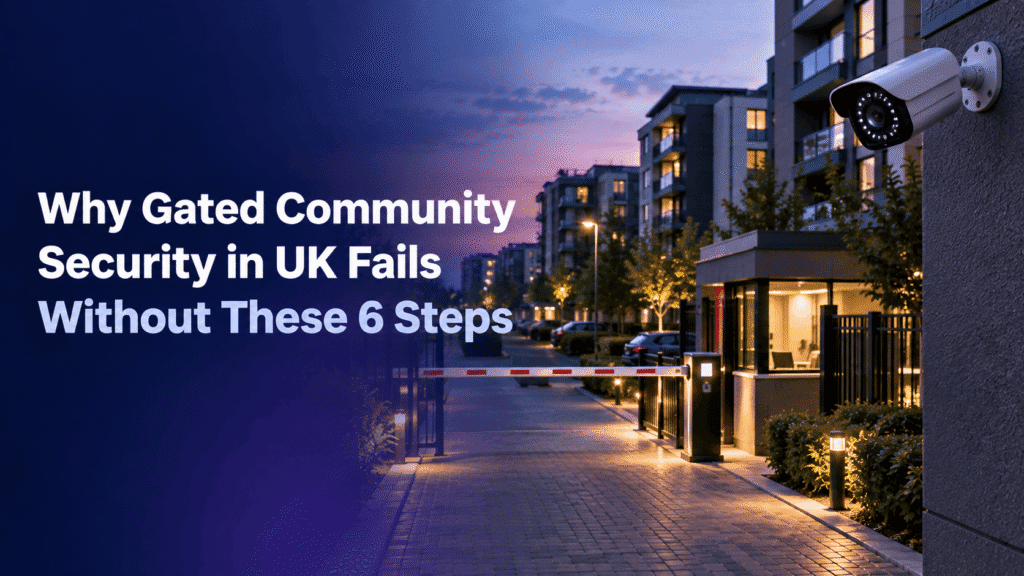
Why Gated Community Security in UK Fails Without These 6 Steps
A locked gate feels like safety. For many residents across the UK, that gate is the entire security plan — a barrier, a camera pointed at the entrance, and an assumption that trouble stops there. It doesn’t. Gated community security in UK developments regularly fails not because the equipment is bad, but because the system around it is incomplete. Cameras record instead of alerting. Gates open for anyone who looks familiar. Nobody is watching when it actually matters.
This guide breaks down exactly where gated community security in UK properties tends to break down, and the six steps that close those gaps for good.
TL;DR
- A gate alone doesn’t stop crime — most gated community security in UK developments fails at monitoring and response, not access.
- Layered access control, live monitoring, and fast response times matter more than the number of cameras installed.
- Two-way audio lets operators intervene in real time, stopping incidents before they escalate.
- Intercom and visitor verification close the “tailgating” gap that most gates never solve.
- Regular audits and resident communication keep the whole system accountable long-term.
Why Gated Community Security in UK Developments Often Falls Short
Direct answer: Gated community security in the UK usually fails because it relies on physical barriers and passive recording rather than active monitoring and fast intervention.
A gate restricts vehicle entry, but it does nothing about someone walking through on foot behind a resident’s car, or a camera that only gets reviewed after a break-in has already happened. Research on gated communities in England has long noted that the sense of security these developments provide doesn’t always match the actual reduction in crime, largely because the systems behind the gate are underused or poorly maintained.
The Gap Between Perception and Reality
Residents assume a gated entrance means constant oversight. In practice, most systems only record footage for later review. By the time anyone watches it, the incident is over. This is the core reason gated community security systems UK-wide need more than hardware — they need a monitoring layer that actually watches in real time.
The 6 Steps That Fix Gated Community Security in UK Properties
Each of these steps addresses a specific failure point. Skipping any one of them leaves a gap that the others can’t fully cover.
Step 1: Layered Access Control, Not Just a Gate
Direct answer: A single gate is one layer; real gated community access control UK developments need multiple checkpoints — vehicle gates, pedestrian entries, and building-level access control working together.
A single failure point means the whole system fails at once. Adding checkpoints at building entrances, car parks, and communal areas means one unlocked gate doesn’t compromise the entire property. Keycards, PIN codes, and app-based entry each add friction that opportunistic intruders won’t bother working around.
Step 2: Live, Human-Monitored CCTV
Direct answer: CCTV for gated communities UK only works as a deterrent when someone is actively watching, not just recording for later.
Live security monitoring means a trained operator sees suspicious activity as it happens and can act — alerting residents, contacting authorities, or triggering an on-site response. Passive recording, by contrast, only ever produces evidence after the fact. This single change is often what separates a security camera from a security system.
Step 3: Fast Response Times, Not Just Recording
Direct answer: The speed between a detected threat and an actual response determines whether an incident is stopped or simply documented.
CCTV monitoring response time matters more than most residents realise. A delay of even a few minutes can be the difference between an intruder being challenged at the gate and an intruder already inside a home. Properties using remote CCTV monitoring for gated communities typically build response-time targets directly into their service agreements.
Step 4: Two-Way Audio and Real-Time Intervention
Direct answer: Two-way audio lets a monitoring operator speak directly to someone on-site, often stopping an incident before it starts.
Hearing a live voice say “you’re being recorded, please leave the property” is far more effective than a silent camera. Two-way audio surveillance gives operators the ability to de-escalate loitering, trespassing, or vandalism in real time, rather than only capturing it on video.
Step 5: Intercom and Visitor Verification
Direct answer: Verifying visitors before they enter closes the tailgating gap that gates alone can’t solve.
Most break-ins at gated properties don’t involve climbing a fence — they involve someone walking in behind a resident or a delivery driver. Intercom monitoring paired with a virtual security guard verifying every visitor before granting access removes this weak point almost entirely.
Step 6: Regular Audits and Resident Communication
Direct answer: Security systems degrade without regular checks — cameras get blocked, gates get propped open, and codes get shared informally.
A quarterly audit of residential surveillance coverage, access logs, and equipment condition catches problems before they become incidents. Clear communication with residents about how to report issues also keeps the whole system accountable, rather than relying on management to notice gaps on their own.
What Happens When These Steps Are Skipped
Skip even one of these, and the whole system weakens. A gate without live monitoring becomes a false sense of security. Live monitoring without fast response times becomes an expensive way to watch a crime happen. According to guidance from the Town and Country Planning Association, safer communities are built through design and active management working together — not through physical barriers alone. Understanding the benefits of CCTV monitoring for societies makes clear that the value comes from the full system, not any single piece of it.
Summary
Gated community security in UK developments fails most often because it stops at the physical barrier. A gate, a few cameras, and passive recording create a false sense of safety without the monitoring and response systems needed to actually stop an incident. Layered access control, live human monitoring, fast response times, two-way audio, visitor verification, and regular audits together close the gaps that a gate alone leaves wide open. Properties that combine all six consistently see fewer incidents — and residents who actually trust the system protecting them.
Frequently Asked Questions
Is gated community security in the UK actually effective?
It can be, but only when access control, live monitoring, and fast response work together. A gate alone provides limited protection against determined or opportunistic intruders.
How much does gated community security guard cost in the UK?
Costs vary by property size and coverage hours, but 24/7 on-site guarding is typically more expensive than remote monitoring, which covers the same hours using camera networks and live operators instead of physical patrols.
What is a smart gate entry system?
A smart gate entry system uses app-based access, PIN codes, or automatic number plate recognition instead of a physical key, allowing management to track exactly who enters and when.
Do gated communities actually reduce crime in the UK?
Evidence is mixed. Gated communities can reduce opportunistic crime, but their effectiveness depends heavily on whether monitoring and response systems back up the physical barrier.
What’s the difference between recorded CCTV and live monitoring?
Recorded CCTV only provides footage after an incident occurs. Live monitoring means an operator watches in real time and can respond immediately, which is what actually prevents incidents rather than just documenting them.
How do I choose a gated community security company in the UK?
Look for providers offering live monitoring (not just recording), documented response-time guarantees, and integrated access control — not just camera installation.